Wednesday 06 / May / 2026
Pakistan's Prime Minister Shehbaz Sharif met with Saudi Crown Prince Mohammad bin Salman in Jeddah on Thursday. The visit comes at a time when the Iran war is entering its third week, with the US and Israel intensifying their attacks on Iran, and Tehran targeting US bases and other areas in Saudi Arabia and neighboring Gulf countries.
"The Prime Minister expressed Pakistan's full solidarity and support for the Kingdom of Saudi Arabia in these challenging times," Mosharraf Zaidi, a spokesman for PM Sharif, posted on X, adding that the two leaders exchanged views on recent regional developments and agreed to work together for peace and stability.
Sharif also assured the crown prince that Pakistan would always stand firmly with Saudi Arabia, the post read.
Since the start of the Iran war on February 28, Islamabad has been trying to present itself as a "neutral" party, which maintains cordial ties with the Arab nations as well as Iran. But keeping this balancing act is not an easy task, and Pakistan could be forced to pick a side should the war continue for a longer period.
Pakistan's balancing act
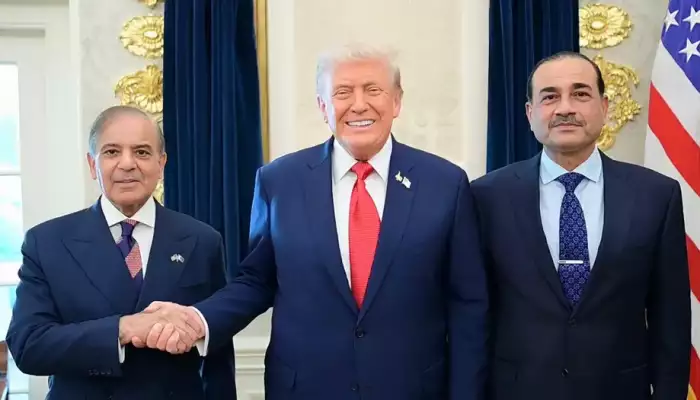
The Pakistani premier and the Muslim-majority country's army chief and field marshal, General Asim Munir, have forged close ties with US President Donald Trump in the past months. Islamabad even joined Trump's controversial Board of Peace, which aims to stabilize the Middle East and oversee peace and reconstruction in the Gaza Strip. In an interview with DW on the sidelines of the Munich Security Conference on February 14, Pakistani Defense Minister Khawaja Asif said that having the US on its side is of great value for Islamabad.
Then why is Pakistan not openly supporting the US?
"Pakistan can maintain working ties with Washington while still refusing to join a military campaign," Fatemeh Aman, analyst and former senior fellow at Middle East Institute and Atlantic Council, told DW. "Entering a war next door would carry major costs: economic disruption, potential instability along the Iran-Pakistan frontier, and the risk of inflaming sectarian tensions inside Pakistan. These factors place clear limits on how far Islamabad can align militarily with the United States," she added.
"Pakistan is signaling diplomatic sympathy while avoiding direct involvement in the conflict. Its priority is to prevent the war from spilling across its western border, destabilizing its domestic environment, or disrupting energy supplies and trade routes," Aman said, adding that a "more accurate description is limited alignment without military entanglement."
Sharif's spokesman Zaidi told DW that his government is pushing for de-escalation. "Pakistan does not support attacks by Iran on Gulf countries or the (US-Israeli) bombing campaign in Iran," he stressed.
But Aman is of the view that Pakistan is "not neutral in the political sense."
"Its official statements have criticized Israeli strikes and expressed support for Iran's sovereignty. But Islamabad is trying to remain non-belligerent in practical terms. It does not want to become a party to the war," she underlined.
But what if Saudi Arabia decides to join the war against Iran?
Can Pakistan be pushed into the war?
Zaidi told DW that "Pakistan will be there whenever Saudi Arabia needs assistance," but Prime Minister Sharif "has (also) been in constant contact with Iranian leadership."
Atlantic Council's Aman believes there are several scenarios that could push Pakistan closer to the war: "If Saudi territory or energy infrastructure come under sustained attack and Riyadh formally requests support, Pakistan would face significant pressure to assist a key strategic partner," she underlined.
"Pakistan's relationship with Saudi Arabia provides economic support, political backing, and security cooperation. But in a conflict involving Iran, that same partnership complicates Islamabad's balancing strategy," Aman said, adding that close ties with Riyadh naturally create expectations that Pakistan will support Saudi security concerns if Gulf stability deteriorates.
Pakistan and Saudi Arabia also have a mutual defense pact, which states that an attack on one country is treated as an attack on both, committing both nations to joint military intervention.
The challenge for Islamabad, according to Aman, is to reassure Saudi Arabia while avoiding a position in which Pakistan becomes part of a broader Saudi-Iran military confrontation.
Other scenarios involve the Iran war's "direct spillover along the Iran-Pakistan border through militant activity, refugee flows, intelligence operations or cross-border strikes," Aman said.
"Finally, internal sectarian tensions inside Pakistan could also intensify as regional rivalries echo within domestic politics," she underlined.
Trump's expectations from Islamabad
Maleeha Lodhi, an international affairs expert and former Pakistani ambassador to the US and the UN, insists Pakistan's position in the conflict is more aligned with Iran.
"Pakistan has condemned the US-Israeli attack on Iran, without naming the US. Pakistani leaders have condoled the death of Supreme Leader Ayatollah Ali Khamenei. The prime minister also congratulated the new supreme leader, and the foreign ministers of the two countries spoke to each other during the war," she told DW.
At the same time, the public sentiment in Pakistan is strongly pro-Iran, she said. "Nevertheless, given Pakistan's close ties with the Gulf Cooperation Council (GCC states), especially Saudi Arabia, with whom it has a defense pact, it has also condemned attacks on them."
Pakistan does not have diplomatic ties with Israel, and the public sentiment is also not in favor of the US-Israeli attacks on Iran.
Analyst Fatemeh Aman, however, believes Donald Trump is unlikely to be taken aback by Islamabad's stance. "Washington doesn't expect Pakistan to enter the war directly. More realistically, the US expects Pakistan to prevent anti-US activities, violence on its soil, avoid providing support to Iran, maintain security and intelligence cooperation, and help ensure that Gulf shipping routes remain open," she underlined.
"If the conflict expands and Saudi Arabia faces direct attacks, US expectations could evolve. In that situation, pressure on Islamabad to support Riyadh could increase significantly, narrowing Pakistan's room to maintain a position of non-belligerence," she added.