Wednesday 15 / July / 2026
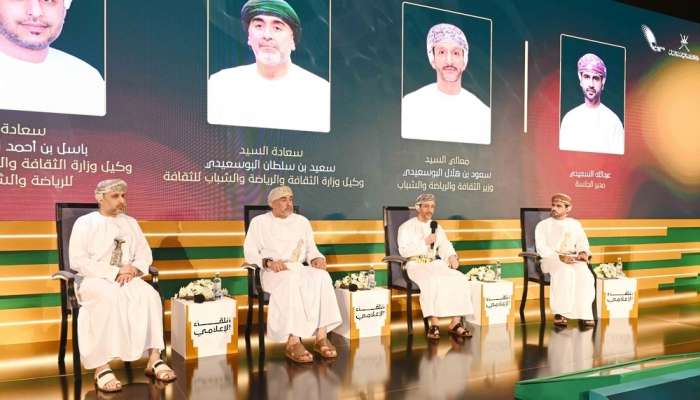
Muscat: The Ministry of Culture, Sports and Youth highlighted its most prominent achievements and performance indicators realized during 2025, alongside its future plans and directions in the culture, sports, and youth sectors, during a media briefing today.
Sayyid Saud Hilal Al Busaidi, Minister of Culture, Sports and Youth, emphasized that the culture, sports, and youth sectors represent an integrated national system for human capacity building, consolidating the Omani identity, enhancing the quality of life, and empowering the youth.
The Minister of Culture, Sports and Youth stated that during the upcoming phase, the Ministry will announce the launch of a package of qualitative programmes and events aimed at discovering, refining, and building the capacities of youth talents, as well as creating an enabling environment for their growth and development.
He pointed out that the Ministry is proceeding with the implementation of its programs and projects according to a vision based on the objectives of Oman Vision 2040. This vision focuses on deepening societal impact, expanding reach to the governorates, developing services and infrastructure, and enhancing the Sultanate of Oman's cultural, sports, and youth presence on both local and international levels.
During the briefing, Al Busaidi indicated that the Ministry implemented 687 activities and events over the past year, benefiting 105,376 individuals across the various governorates of the Sultanate of Oman.
These were distributed over 242 cultural activities with 27,256 beneficiaries, 298 sports activities with 57,423 beneficiaries, and 147 youth activities with 20,697 beneficiaries, reflecting the breadth of cultural, sports, and youth mobility and the reach of its programs to various segments of society.
Regarding international cooperation and partnerships, he reported that the number of memoranda of understanding during the period from 2022 to 2025 reached approximately 15, in addition to 9 executive programs in the fields of culture, sports, and youth. These aim to enhance the Sultanate of Oman's presence in regional and international forums and broaden the horizons of knowledge, cultural, sports, and youth exchange with various countries and institutions.
For his part, Sayyid Said Sultan Al Busaidi, Undersecretary of the Ministry of Culture, Sports and Youth for Culture, explained that cultural work in the Sultanate of Oman stems from a vision based on the constants of citizenship and Omani identity. It is linked to the targets of Oman Vision 2040 within an institutional direction that seeks to achieve sustainable cultural development and forge an Omani cultural scene that reflects creativity, diversity, and civilizational presence.
He indicated that what has been achieved in the cultural sector over the past years reflects a growing trajectory in supporting writers, researchers, and creators, developing cultural institutions and programs, and expanding the areas of cultural work to consolidate its presence and impact on society. He noted that the next phase aims to deepen cultural impact, expand partnerships, and enhance infrastructure, services, and legislation, thereby reinforcing the Sultanate of Oman's position as a leading cultural destination with a firmly established identity.
The Undersecretary added that the Cultural Strategy 2021-2040 is based on seven main pillars. These include creativity and cultural development, culture and society, cultural creative industries, cultural identity, cultural development, cultural regulations and legislations, and cultural communication. This is in addition to multiple fields aimed at enhancing identity and creativity, including intangible cultural heritage, translation and publishing, literature, manuscripts, visual and performing arts, and cultural events, competitions, and awards.
He stated that the total activities of the cultural sector within the Tenth Five-Year Plan reached 900 activities and events, benefiting 85,733 participants. This is alongside supporting 451 artistic groups, implementing 46 cultural initiatives, and conducting 23 research studies.
Furthermore, the Sultanate of Oman was hosted as a guest of honor at 5 international book fairs, while 18 elements of intangible cultural heritage were inscribed on UNESCO's lists, comprising 5 national elements and 13 shared elements.
The Undersecretary of the Ministry of Culture, Sports and Youth for Culture said that the United Nations Educational, Scientific and Cultural Organization (UNESCO) adoption of the UNESCO-Sultan Haitham Prize for Intangible Cultural Heritage Safeguarding—a national initiative presented by the government of the Sultanate of Oman to be awarded biennially—aims to honor institutions, organizations, centers, and community entities with impactful contributions to the safeguarding, transmission, and promotion of intangible cultural heritage. This affirms the Sultanate of Oman's presence in supporting the pathways of international cultural cooperation.
He added that the Arab League Educational, Cultural and Scientific Organization (ALECSO) awarding His Majesty Sultan Haitham bin Tarik, the Arab Cultural Excellence Medal of the Highest Order—the first medal awarded by the organization since its establishment in 1970—embodies Arab appreciation for the prestigious cultural and civilizational standing held by the Sultanate of Oman. It is also an acknowledgment of the pioneering role His Majesty undertakes in consolidating culture and knowledge, and enhancing the pathways of intellectual and cognitive development in the Arab world.
He explained that among the most prominent strategic cultural projects is the Sayyid Tarik bin Taimur Cultural Complex. It encompasses the National Theatre, the National Library of Oman, the House of Arts, the Literary Forum, the Cultural Cinema, and various cultural facilities.
The completion rates for the project's components have reached 49% for the Literary Forum, 46% for the House of Arts, 41% for the Cultural Cinema, 38% for the National Library of Oman, and 32% for the National Theatre.
He clarified that the Ministry continues to support intellectual and literary output, enhance the presence of Omani books in international forums, and implement qualitative programs and initiatives in the fields of translation, oral history, the digitization of publications, and support for Omani authorship.
This is in addition to paying attention to children's culture and developing their creative capabilities through specialized awards, competitions, workshops, and theatrical performances.
He concluded by stating that the Ministry is working on developing a supportive environment for creative industries and enhancing their economic and cultural contribution. This is achieved through capacity-building programs and qualifying national cadres in various arts fields, alongside the leadership program in the creative industries sector in cooperation with the Royal Academy of Management, contributing to the empowerment of national talents and the development of creative career paths.
In a related context, Basil Ahmed Al Rowas, Undersecretary of the Ministry of Culture, Sports and Youth for Sports and Youth, affirmed that work in the sports sector stems from a clear vision linked to the targets of Oman Vision 2040. This is embodied in the Omani Sports Strategy 2040, which seeks to build an advanced sports system that promotes community health, supports competitiveness, and consolidates the position of sports as a realm for development, achievement, and investment.
Al Rowas pointed out that what has been accomplished in the sports sector during the past years reflects an expanding trajectory in supporting athletes, empowering sports federations and bodies, widening the base of practice, achieving accomplishments, and hosting events, all of which enhance the Sultanate of Oman's presence at the regional and international levels.
He explained that the Ministry supported more than 30 international and regional sports events hosted in the Sultanate of Oman, alongside implementing several programs and initiatives supporting community sports and sports for people with disabilities. He pointed out that the National Program for Discovering and Building the Capacities of Talented Athletes aims to discover and refine sports talents, enhance integration between the educational and sports sectors, and prepare a generation of athletes capable of competing regionally and internationally.
He added that the youth sector stems from a national direction linked to the objectives of Oman Vision 2040, the features of which are embodied in the National Youth Strategy 2040. This strategy is based on empowerment, capacity building, expanding opportunities, and developing qualitative programs through active partnerships and initiatives that respond to youth aspirations and keep pace with future transformations.
The Undersecretary stated that the National Youth Strategy project, which is being prepared according to a participatory and field-based approach, involved the participation of more than 1,000 young men and women. It was developed using methodological tools to analyze the reality of youth in accordance with scientific methodologies and global practices.
During the meeting, Al Rowas announced the future plans and programs of the Youth Center, and the strategic expansion of the center in the governorates through a number of projects and branches in Musandam, South A’Sharqiyah, North Al Batinah, A’Dhahirah, Dhofar, Al Buraimi, and A’Dakhiliyah. This expansion will enhance the reach of youth programs to various demographics and support the incubating environment for talents, innovation, and youth initiatives.
The Undersecretary of the Ministry of Culture, Sports and Youth for Sports and Youth concluded by emphasizing that the achievements, indicators, and future plans realized by the Ministry reflect the magnitude of the growing momentum across its three sectors. He noted that culture, sports, and youth represent an integrated system for building human capacity, enhancing the quality of life, consolidating national identity, and shaping the future.