Wednesday 03 / December / 2025
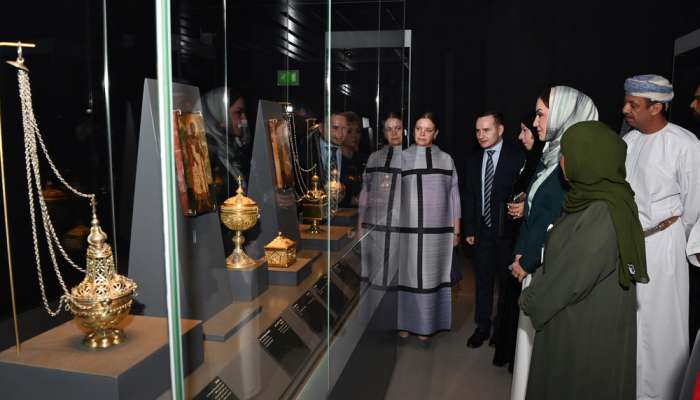
Muscat: On the occasion of the 40th anniversary of the establishment of diplomatic relations between the Sultanate of Oman and the Russian Federation, the National Museum today inaugurated the exhibition “Russia and the Middle East: International Relations and Cultural Influences” from the Moscow Kremlin Museums collection.
The opening ceremony was held under the patronage of HH Sayyedah Dr. Mona bint Fahd bin Mahmoud Al Said, Assistant Vice-Chancellor of Sultan Qaboos University for International Cooperation and Deputy Chairman of the Board of Trustees of the National Museum.
The opening of this exhibition comes as an extension of the ongoing cooperation between the two sides. In July 2024, the National Museum inaugurated the “The Splendor of Silver: Treasures from the Omani Court” exhibition and Oman Day activities at the Moscow Kremlin Museums, with the aim of marking the manifestations of Omani silver as a historically pioneering craft and showcasing a curated selection of artefacts belonging to the Sultans of Oman in Muscat and Zanzibar.
The exhibition features more than 80 artefacts of exceptional historical and artistic value, some of which are being displayed outside the Russian Federation for the first time, while others have never before left the walls of the Kremlin in Moscow—the oldest part of the Kremlin collection. These precious pieces, brought from various Eastern countries, were carefully preserved for centuries in the treasuries of Russian sovereignty and later became crown jewels of the Armoury Chamber Museum, including weapons, armor, horse adornments and decorative artworks.
One of the most significant and intriguing themes highlighted by the exhibition is the influence of Eastern art on the jewelry and weapon workshops of the Russian royal court, as well as on the overall appearance of the Russian court during the 16th and 17th centuries. Also, on display are items that showcase the use of precious incense—frankincense, traditionally imported to Russia from Oman. The exhibition will remain open to the public until 3 April 2026.
Oleg Vladimirovich Levin, Ambassador of the Russian Federation to the Sultanate of Oman, delivered a speech in which he stated that cultural cooperation between the Sultanate of Oman and the Russian Federation is witnessing remarkable growth, reflecting the depth of the ties between the two countries’ peoples.
He affirmed that the National Museum’s hosting of the “Russia and the Middle East: International Relations and Cultural Influences” exhibition from the Moscow Kremlin Museums Collection represents an important milestone in the shared cultural journey, highlighting the mutual commitment to preserving heritage and enhancing cultural exchange. He also commended the joint efforts in organizing artistic and museum events throughout the year, emphasizing that culture remains a lasting bridge for communication and understanding among nations. He concluded by expressing his hope that the exhibition will further contribute to fostering intellectual and cultural closeness.
Dr. Elena Gagarina, General Director of the Moscow Kremlin Museums, affirmed in her speech that the exhibition comes in celebration of the 40th anniversary of the establishment of diplomatic relations between the Sultanate of Oman and the Russian Federation. She noted that it forms an integral part of the international arts and culture festival “Russian Seasons”, organized by the Government of the Russian Federation and the Russian Ministry of Culture and held in the Sultanate of Oman. The festival, coinciding with this anniversary, serving the purpose of strengthening and developing cultural diplomacy.
She added: “This project continues the fruitful collaboration between our museum and the National Museum of the Sultanate of Oman. In 2024, the exhibition ‘The Splendor of Silver: Treasures from the Omani Court’ was held at the Kremlin Museums in Moscow and achieved great success, with total visitor numbers exceeding thirty thousand. I hope that the exhibition ‘Russia and the Middle East: International Relations and Cultural Influences’ will offer its visitors an unforgettable impression with unique works of masters from the past, and that it will become a significant milestone along the path of expanding cultural dialogue between our two countries.”
The Kremlin Museums in Moscow receive around two million visitors each year, and house more than 160,000 artworks preserved within the Kremlin Museums, in addition to over 4,000 pieces permanently displayed in the Armoury Chamber. The collections date from the late third millennium BC up to the present day, with the main portion of the museum’s holdings belonging to the period of medieval Russian history and the modern era.
--- Ends/Khalid