Monday 15 / December / 2025
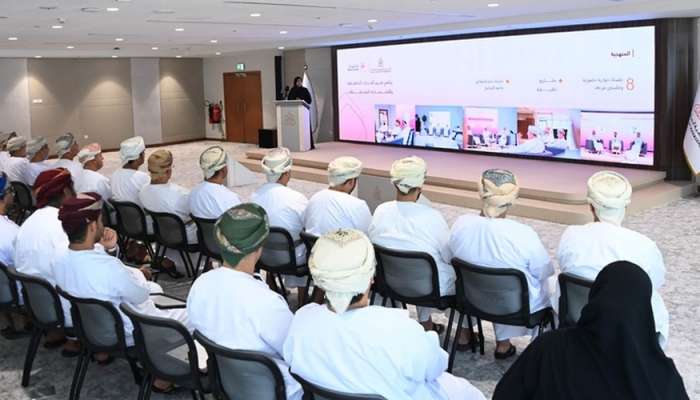
Muscat--- Under the patronage of Dr. Said bin Mohammed Al Saqri, Minister of Economy, the Royal Academy of Management (RAM), in cooperation with the Ministry of Economy, today concluded the Governorates’ Planning and Economic Capacity Building Programme.
Marking a decisive shift in the approach to national development, from managing services to strategically shaping the economy, the programme was implemented in alignment with the Royal vision of His Majesty Sultan Haitham bin Tarik, aiming to cultivate competent national leaders capable of contributing effectively to the objectives of Oman Vision 2040.
The programme aimed to build strategic economic foresight and equip national leaders with analytical depth and adaptive capacity to interpret global and regional economic shifts, re-engineer development priorities, and design future-ready economic pathways at the governorate level. In doing so, the programme addressed accelerating geo-economic transformations that have been redefining leadership, competitiveness, and development models both globally and nationally.
This approach reflects a broader national transition toward leadership models that sustain resilience, competitiveness, and long-term economic value creation. As economic complexity intensifies and traditional development paradigms rapidly erode, the programme underscores a fundamental reality: Effective leadership today is no longer defined by authority alone, but by the ability to understand, anticipate, and navigate the dynamics of the new economy. Leaders who fail to grasp these transformations, regardless of their mandate, are increasingly unable to translate authority into a real impact.
Dr. Ali bin Qasim Al Lawati, Chairman of the Royal Academy of Management, said that the programme embodies the Royal vision of His Majesty Sultan Haitham bin Tarik, which places the development of empowered, future-ready leadership at the heart of national development. He underlined that the current and upcoming phases of Oman’s development journey require a new calibre of leaders capable not only of managing institutions but also of comprehending and navigating the growing complexity of the global and regional economic environment.
According to him, economic capacity building goes beyond conventional skill development. Instead, it represents a strategic investment in competencies and enablers that equip leaders with the ability to decode the dynamics of the new economy and engage deeply with the requirements of specialised economic sectors, which in turn enhance the nation’s comparative advantages and long-term competitiveness. The programme was designed as more than a traditional training initiative, positioning it instead as an integrated foundational platform for re-examining both local and global economic realities and for engineering sustainable development pathways that transcend short-term interventions.
Dr. Ali Al Lawati also noted that this approach reinforces the principle that economic leadership empowerment is a cornerstone of the national economic diversification strategy, ensuring coherence among development initiatives, decentralisation objectives, and the overarching national agenda.
He further highlighted that the world is undergoing profound and accelerated economic transformations that are reshaping established models of development and competitiveness. Therefore, national resilience and adaptability are no longer determined solely by the availability of resources, but by national leadership endowed with economic foresight, leaders who can anticipate change, interpret complex economic shifts, and transform global and local challenges into sustainable development opportunities.
Dr. Nasser bin Rashid Al Maawali, Undersecretary of the Ministry of Economy, emphasised that implementing the Governorates’ Planning and Economic Capacity Building Programme reflects an integrated government approach to advancing decentralisation and strengthening the role of governorates in defining and prioritising their development agendas. He noted that the programme engaged 50 participants from across the governorates and used a comprehensive methodology that effectively combined theoretical foundations with practical application, while providing an interactive platform for dialogue and the exchange of expertise among participants.
Dr. Al Maawali added that the programme’s evaluation results were highly positive, underscoring the quality of its content, delivery, and overall impact by enhancing participants’ knowledge and professional capabilities. He emphasised that the Ministry of Economy, in collaboration with its partners, will continue investing in capacity development in administrative and economic decentralisation and equipping governorates with best practices that support sustainable development, accelerate local growth, and enhance the competitiveness of governorates nationwide.
The programme served as a specialised capacity-building framework to enhance the capabilities of national leaders and strengthen institutional competencies in governorates and executive entities. Aligned with international standards and designed to support integrated development efforts across the governorates, it focused on boosting skills in economic and development planning, budgeting, performance indicator formulation, and the application of best practices, models, and tools.
The programme equipped participants with knowledge, competencies and skills in local administration and its role in achieving economic decentralisation and governorate development, as well as in contract management, economic analysis, strategic planning, and investment promotion, enabling them to develop comprehensive frameworks that support the governorates’ strategy.
The programme also focused on aligning various initiatives with stakeholders to strengthen cross-sectoral integration, and introduced project evaluation and selection frameworks with implementation mechanisms in line with governorates’ development priorities. Its delivery combined specialised learning modules, field visits, collaborative team and applied projects, and strategic presentations, ensuring a practical focus and measurable skill development.
Through the launch of strategic initiatives and programmes aligned with the requirements of key sectors across the Sultanate of Oman, RAM continues to strengthen its pioneering role in empowering national leadership. These efforts aim to accelerate sustainable development and enhance institutional efficiency, reflecting RAM's commitment to contributing to comprehensive national development.




