Friday 09 / January / 2026
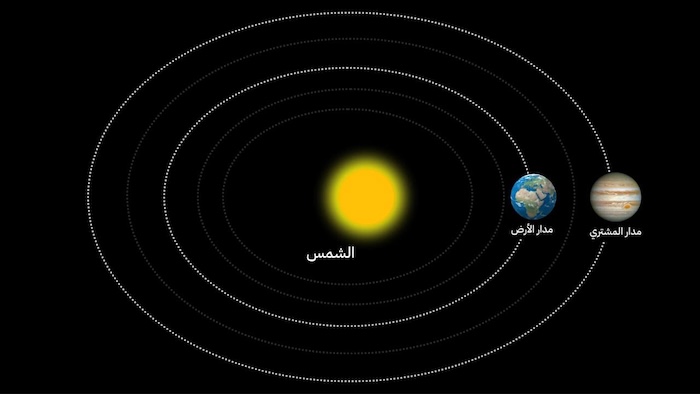
Muscat: The Oman Astronomical Society has announced that the planet Jupiter will reach opposition with Earth tomorrow, January 10, 2026, at exactly 12:34 PM local time. During this event, Jupiter will be positioned directly opposite the Sun from our perspective on Earth.
This alignment brings the gas giant to its closest point to our planet for the entire year—approximately 633 million kilometers away—making it appear exceptionally large and luminous.
Mukhtar bin Saif Al-Saidi, Head of Astronomical Programs at the Society, explained that opposition occurs when an outer planet lies directly opposite the Sun from Earth’s perspective. During this alignment Jupiter, Earth, then the Sun the planet reaches its closest point to Earth for the year.
At opposition, Jupiter will be approximately 633 million kilometers from Earth, with an apparent magnitude of –2.8, making it one of the brightest objects in the night sky easily visible to the naked eye across Oman.
Jupiter will appear at its brightest and largest, making it an ideal target for observation and astrophotography. It will rise over Muscat at 5:29 PM and set at 6:54 AM the next morning, reaching its highest point around midnight.
As the second-brightest planet after Venus, Jupiter is a gas giant with no solid surface and is the largest planet in the solar system by both size and mass. It has four major moons—known as the Galilean moons—which can be seen with small telescopes or binoculars. Larger telescopes can reveal its iconic cloud bands and the Great Red Spot.
Currently located in the constellation Taurus, Jupiter will be visible in the eastern sky after sunset and will move westward through the night. It will remain visible for several months before gradually fading as it approaches solar conjunction on July 29, 2026.
Al-Saidi emphasized Jupiter’s crucial role in stabilising the solar system. Its massive gravity helps deflect or capture comets and asteroids, reducing the risk of impacts on Earth—earning it the nickname “the solar system’s shield.” It also contributes to the orbital stability of other planets.
He concluded by noting that Jupiter’s opposition occurs roughly every 13 months due to the differing orbital periods of Earth and Jupiter—Earth completes one orbit in a year, while Jupiter takes about 12 years.
This celestial event offers a prime opportunity for astronomy enthusiasts to observe Jupiter under optimal conditions and to appreciate its significance in the cosmic order.




