Tuesday 27 / January / 2026
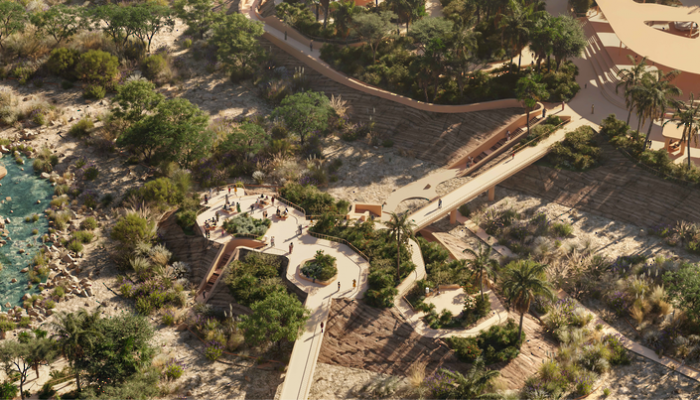
Muscat: Sultan Haitham City is witnessing a significant acceleration in the implementation of its infrastructure and primary facility packages.
This progress coincides with the issuance of three new construction tenders within Package Nine of the city's works, covering streetscaping and aesthetic landscaping for main roads, the execution of the Central Park and Wadi, and the construction of the Rehabilitation Complex for Persons with Disabilities.
These tenders are part of an advanced executive track, following the awarding of eight infrastructure construction packages with an investment value of OMR205 million, as work advances across residential neighbourhoods and vital city facilities.
The newly issued tenders include Package (9-A) for streetscaping and aesthetic landscaping of main roads, covering afforestation, pavement treatments, decorative elements, and urban facades for the city’s primary movement axes.
Package (9-B) focuses on the construction of the Central Park and Wadi, including all construction and infrastructure works to develop the city's primary green space across 1.64 million square metres.
This area will feature a network of pedestrian paths, bridges, event zones, water features, and open natural spaces, positioning it as a hub for daily life, recreation, and community activities.
Eng. Amal Al Zaidi, Urban Planner and Landscape Engineer at the Executive Office for Future Cities Projects at the Ministry of Housing and Urban Planning, stated that Sultan Haitham City was designed to be inclusive.
She emphasised that public spaces are a fundamental pillar in building a balanced city that serves various segments of society, noting that the Central Park and Wadi form the vital heart of this vision.
She explained that the 1.64-million-square-metre space will serve the residents and visitors of Muscat Governorate at large, providing a green urban sanctuary for daily use through a connected network of paths, recreation zones, and activity facilities.
She added that the design enhances connectivity between neighbourhoods and vital facilities through the wadi and natural paths, contributing to improved quality of life, public health, and social interaction within a human-centric urban model.
The tenders also cover the construction of the Rehabilitation Complex for Persons with Disabilities, in collaboration with the Ministry of Social Development. This project presents an advanced national model for care and rehabilitation through five specialised tracks in a single facility with a capacity for 360 cases.
The complex will house specialised facilities, including flexible therapeutic spaces, sensory environments for autism spectrum disorder, physical therapy and motor rehabilitation zones, vocational training halls, and therapeutic gardens.
It also includes community facilities accessible after working hours, such as a gymnasium and a theater. The center is being built on an area exceeding 10,000 square metres, with a total built-up area of 16,000 square metres.
Eng. Ma’ather Al Nabhani, Urban Planner and Architectural Designer at the Executive Office for Future Cities Projects, stated that the rehabilitation center was designed to consolidate early intervention services, autism rehabilitation, mental and physical disability care, and vocational training within a supportive human environment that prioritises accessibility and service quality.
She added that the centre provides flexible spaces to enhance social integration, with facilities serving the community after hours. This partnership with the Ministry of Social Development ensures integrated roles, sustainable operations, and high-quality services aligned with national goals for social inclusion and support for persons with disabilities.
Sultan Haitham City is undergoing parallel implementation of its major infrastructure packages. The levelling and preparation for Phase One within Package One is 100% complete.
To achieve accessibility goals, bridge and road works have reached advanced stages, with bridges in Package Two at 70.7% completion and roads in Package Four at 37%.
The Experience and Sales Centre in Package Three has reached 99.2% completion. Infrastructure service networks in Package Five are at 33.1%.
Meanwhile, in the energy sector, the construction of three 33/11 kV power stations in Package Six has surpassed 91.1% completion. In the wastewater sector, the main line for Phase One in Package Seven is 51.6% complete, and work on the wastewater treatment plant in Package Thirteen has commenced, reaching 5% completion.
--