Monday 16 / March / 2026
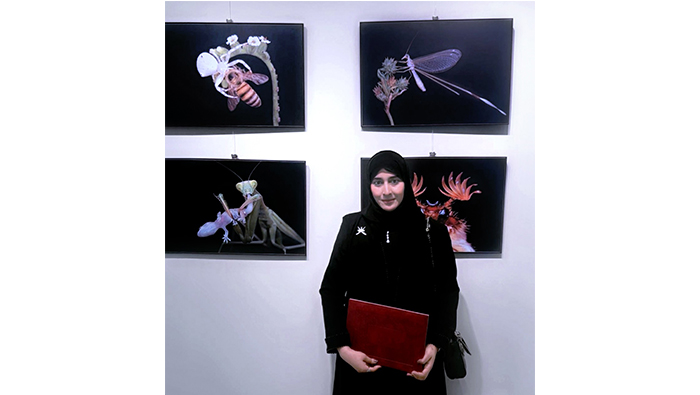
Ibri: Art serves as a powerful conduit for documenting culture and environment, inspiring humanity to perceive the world with heightened awareness and deeper appreciation for the beauty embedded within its myriad details. It offers a creative medium through which visions of life and the natural world are expressed with imagination and emotion.
Through the intricate discipline of insect macro photography—a specialised genre dedicated to revealing details that elude the naked eye—Omani photographer Ghaniya Al Majrafi unveils a miniature universe teeming with astonishing forms, vibrant colours, and intricate behaviours. Her lens captures the hidden wonders of Oman's natural environment, illuminating the nation's remarkable biodiversity.
In an interview with the Oman News Agency (ONA), Ghaniya Al Majrafi reflected on her journey: "I began photography in 2017, and through this art form, I have documented numerous insect species within Oman's ecosystems, some appearing through my lens for the first time. Insect photography holds multidimensional value: artistically, it reveals the beauty of composition, colour, and delicate patterning; scientifically, it contributes to documenting species and behavioural details invaluable to researchers and entomologists; and environmentally, it fosters awareness of insects' essential roles in pollination and organic decomposition, which sustain ecological equilibrium."
She elaborated on Oman's unique environmental character: "Oman's diverse topography and climate foster an extraordinary variety of insect life. By documenting these creatures photographically, we provide researchers and enthusiasts with high-resolution imagery and precise morphological details, serving as a vital visual resource for environmental and taxonomic studies while illuminating an often-overlooked dimension of our national biodiversity."
Al Majrafi acknowledged technology's transformative impact on macro photography, from specialised lenses to focus stacking techniques that render minute details with exceptional clarity. Social media platforms, she noted, have further amplified the reach of this art, connecting knowledge with broader audiences.
The photographer candidly addressed the challenges inherent to her craft: subjects diminutive in size and swift in movement, environmental variables such as wind and heat that compromise stability, and the necessity of accessing specimens concealed within dense vegetation or confined spaces. Above all, she emphasised, the discipline demands boundless patience to seize the decisive moment.
Central to Al Majrafi's practice is an unwavering commitment to ethical documentation—respecting the environment and its smallest inhabitants, capturing wildlife without disturbance or harm. Through her portfolio, she disseminates images accompanied by educational information, challenging prevailing misconceptions that insects are predominantly harmful. Many, she stresses, are indispensable allies in sustaining natural processes.
Her aspiration extends beyond personal achievement: "I hope through this art to inspire others to discover this miniature world and view it through a transformed perspective—one founded on understanding, respect, and commitment to biodiversity protection."
Ghaniya Al Majrafi's exceptional work has garnered acclaim across local, regional and international competitions, most notably securing second place in the prestigious British Luminar Bug Photography Awards. Her images have graced numerous photography platforms and exhibitions, while her informative publications continue to enrich both scientific and visual discourse on insect diversity throughout the Sultanate of Oman.