Thursday 18 / June / 2026
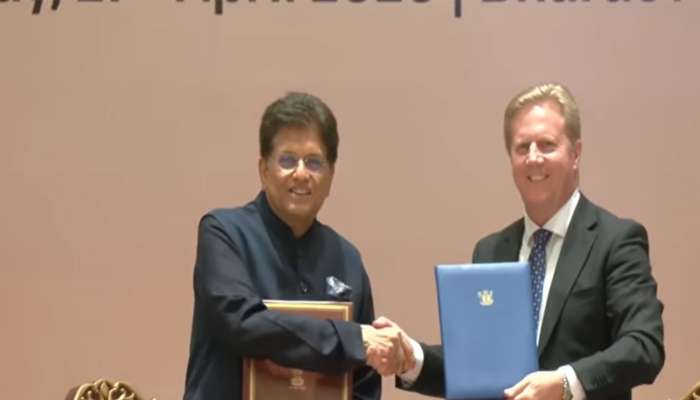
New Delhi: India and New Zealand signed the Free Trade Agreement (FTA) on Monday, marking a significant step in strengthening bilateral economic ties, with the pact expected to bring deep tariff cuts, expanded market access and enhanced services cooperation.
The deal signed between India's Commerce and Industry minister Piyush Goyal and New Zealand, Minister for Trade and Investment Todd McKlay is being described as one of India's fastest concluded bilateral trade deals.
The FTA discussion concluded in December 2025, after negotiations that began in March the same year, is being described as one of India's fastest trade deals to move from negotiations to signing in just nine months.
The agreement follows earlier negotiations that had stalled after multiple rounds, primarily over concerns related to India's dairy sector. The renewed deal reflects a more calibrated approach, balancing market access with sectoral sensitivities.
Under the pact, New Zealand has committed to invest around $20 billion in India over the next 15 years, while also easing trade barriers and simplifying standards and dispute settlement mechanisms.
Bilateral merchandise trade between the two countries has shown fluctuations in recent years, with India's exports and imports both witnessing periodic rises. Services trade has gained momentum, with India's services exports to New Zealand rising by about 13 per cent to reach $634 million in 2024, while imports grew by around 7 per cent to $611 million.
Key Indian exports include pharmaceuticals, machinery, textiles, and precious stones, whereas imports from New Zealand are dominated by wool, metals, fruits, nuts and aluminium.
India stands to benefit from immediate tariff elimination by New Zealand on a large number of product lines. Currently, duties of roughly 10 per cent apply on several Indian exports across categories such as textiles, leather goods, carpets, ceramics and automotive components. The removal of these barriers is expected to boost competitiveness.
Agricultural exports, including tea, coffee and spices are also likely to see improved market access.
India has offered market access on roughly 70 per cent of tariff lines while keeping about 30 per cent excluded. Tariffs will be eliminated immediately on nearly 30 per cent of goods, while over one-third will see phased reductions. A small proportion will be subject to limited tariff cuts, and certain items will fall under quota-based concessions.
Dairy products such as milk, cheese, butter and yoghurt have been kept out of the agreement, reflecting India's domestic sensitivities. Several other categories--including certain animal products, sugar, oils, gems and jewellery, and some metals--are also excluded.
However, selected agricultural products like apples, kiwifruit and manuka honey will be allowed under tariff rate quotas, enabling controlled imports while facilitating technology transfer and productivity improvements through cooperation initiatives.
New Zealand has agreed to open over 100 services sectors to Indian providers and extend favourable treatment across a wider range of sub-sectors. In return, India will liberalise more than 100 services segments for New Zealand, though preferential treatment will apply to a smaller subset.
The agreement includes provisions to ease mobility of professionals and students. There will be no cap on Indian students, with extended post-study work opportunities in science, technology, engineering and mathematics fields. Additionally, up to 5,000 visas will be available at any time for skilled Indian professionals across sectors such as IT, healthcare, education, construction and traditional wellness fields.
The agreement will require ratification by both countries before implementation. While India will complete the process through executive approval, New Zealand will need parliamentary clearance, which could take several months.
Once operational, the FTA is expected to significantly deepen trade and investment flows, while opening new avenues for cooperation across goods, services and human capital.