Wednesday 13 / May / 2026
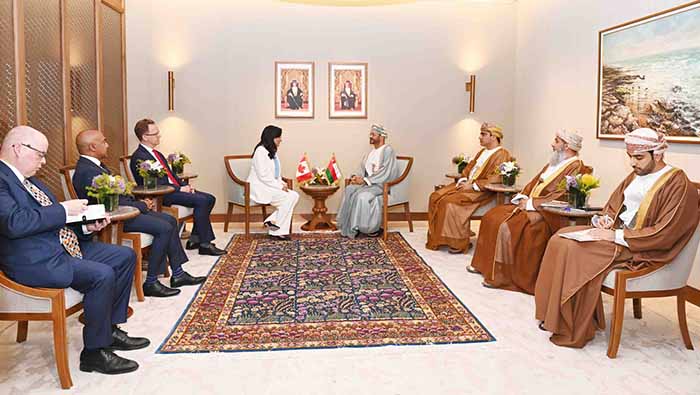
Muscat: The bilateral relations between the Sultanate of Oman and Canada represent an evolving model of diplomatic and economic cooperation, rooted in an extended history since their official inception on 2 February, 1974.
This development comes amid mutual keenness from the leaderships of the two countries to strengthen their strategic partnership and diversify its investment and cultural trajectories.
Political relations between the two nations are witnessing high-level momentum, evidenced by direct phone calls involving His Majesty Sultan Haitham bin Tarik with the Canadian side. These included two phone calls from former Canadian Prime Minister Justin Trudeau and a phone call from Mark Carney, the current Prime Minister of Canada.
This is in addition to ongoing diplomatic meetings and mutual consultations between the foreign ministers of both countries at international forums, such as the United Nations General Assembly in New York, to coordinate positions and exchange views.
In terms of diplomatic representation, Jean-Philippe Linteau has served as the non-resident Ambassador of Canada to the Sultanate of Oman since his appointment in May 2023. Meanwhile, Ali Kamal Daud, Chairman of the Oman American Business Centre, assumes the duties of the Honorary Consul of Canada in Muscat. Conversely, Talal bin Sulaiman Al Rahbi, the Sultanate of Oman’s Ambassador to the United States of America, has received approval to present his credentials as Oman’s non-resident Ambassador to Canada. Within the framework of official visits aimed at consolidating economic ties, Scott Gilmore, Senior Advisor to the Prime Minister of Canada, paid an official visit to the Sultanate of Oman on 29 April 2026. During the visit, he met with the Foreign Minister to discuss promising investment opportunities.
These visits build upon the strategic report submitted by Robert Oliphant, Parliamentary Secretary to the Canadian Minister of Foreign Affairs, following his visit to the Sultanate of Oman in November 2022. In the report, he emphasized to the Canadian Foreign Ministry the necessity of enhancing cooperation with the Sultanate of Oman given its pivotal role in addressing regional challenges.
The mining and energy sector represents one of the most prominent pillars of current economic cooperation. A specialised Canadian trade delegation visited the Ministry of Energy and Minerals from 19-20 January 2026, to explore opportunities for technical partnership and investment in the mineral wealth of the Sultanate of Oman.
These aspirations are further reflected in the intensive meetings held by the non-resident Canadian Ambassador with the Undersecretary of the Ministry of Energy and Minerals, the Chief Executive Officer of Energy Development Oman, and the Chief Executive Officer of Minerals Development Oman.
Notably, Canadian investments maintain a solid presence in the Omani market, with approximately 280 Canadian companies operating with an estimated total capital of around OMR37 million.
On the cultural and educational front, academic cooperation stands out as a primary driver for bridging perspectives between the two peoples.
Oman sponsors over 250 male and female students to complete their undergraduate and postgraduate studies at Canadian educational institutions. This includes sending doctors and medical professionals from the Ministry of Health to benefit from advanced medical expertise in Canada.
Regarding Canada’s domestic sphere and global economic indicators for 2025, Canada ranks as the tenth-largest economy in the world with a GDP of $2.3 trillion.
This is supported by a diversified industrial base combining traditional industries such as oil, gas, mining, and timber, with high-value-added advanced industries like aerospace manufacturing through the pioneering company “Bombardier,” and the automotive industry, which is structurally linked to the American market. This is coupled with the accelerated growth of the software, space technology, and artificial intelligence sectors.
Canada is the second-largest country in the world by land area and possesses the longest international coastline. It contains approximately 20 percent of the Earth’s freshwater, which contributes to securing 60 percent of its electricity needs through hydroelectric power. The country is characterised by a low population density of about 4.5 people per square kilometre, with a total population reaching 40 million people (compared to 17 people per square kilometre in the Sultanate of Oman).
The Canadian political landscape has witnessed fundamental transformations following the resignation of former Prime Minister Justin Trudeau after nine years in office. Mark Carney assumed the position of Prime Minister in March 2025, inaugurating a new phase that included launching a Canadian sovereign wealth fund, reducing interprovincial trade barriers, and expanding defense spending.
Additionally, prominent diplomatic steps were taken, notably Canada’s recognition of the State of Palestine, and the diversification of foreign economic partnerships to counter trade pressures. This is particularly significant following the US administration’s imposition of 25 percent tariffs on Canadian exports, 75 percent of which are directed to the US market across the world’s longest shared border, measuring 8,891 kilometers.
Immigration remains the primary source of demographic and economic growth in Canada, protecting the country from the challenges of demographic aging. Individuals born outside Canada make up nearly a quarter of the total population, with India, the Philippines, and the People’s Republic of China topping the list of countries exporting skilled migrants. Concurrently, Canada takes on the responsibility of resettling more than 10 percent of migrants globally on an annual basis, which supplies the labor market with a highly skilled workforce that supports the trajectory of innovation and sustainable economic growth in Canada.