Tuesday 07 / July / 2026
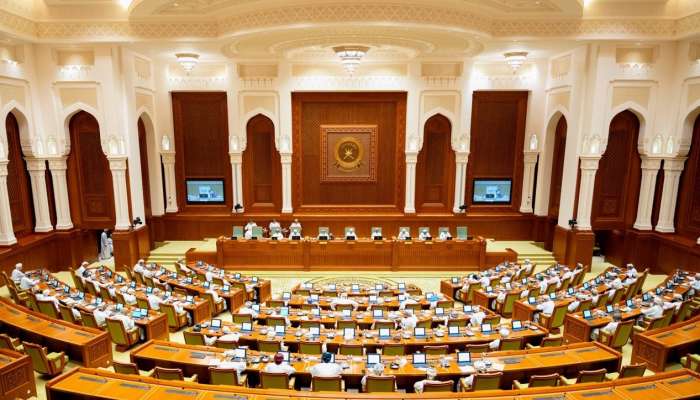
Muscat: The Shura Council has received the Royal Orders of His Majesty Sultan Haitham bin Tarik directing the conclusion of the Third Ordinary Session (2025–2026) of the Tenth Term (2023–2027) of the Shura Council, effective Sunday, 12 July 2026, pursuant to Article (41) of the Council of Oman Law (Royal Decree No. (7/2021), which stipulates that the convening and adjournment of the Council of Oman, in both its ordinary and extraordinary sessions, shall be by Royal Order.
Ahmed Mohammed Al Nadabi, Secretary General of the Shura Council, who stated that the Council successfully completed its legislative work during the Third Ordinary Session, adding further achievements to those accomplished during the first and second sessions of the Tenth Term.
These accomplishments reflect the Council’s commitment to advancing the objectives of Oman Vision 2040 by developing a robust legislative framework that supports national priorities, while carrying out the competencies assigned to it under the Council of Oman Law.
This was clearly demonstrated through the Council’s legislative and oversight activities across a wide range of sectors.
He added that, over the course of the first three ordinary sessions of the Tenth Term, the Council achieved( 73) legislative accomplishments, including the review of draft laws and international agreements referred by the Government, as well as proposing new legislation and amendments to existing laws in support of the Sultanate of Oman’s ongoing development and modernisation.
The Council also strengthened its oversight role through the active engagement of Members of the Shura Council in both standing committee work and plenary discussions.
Across the first three sessions, the Council recorded (647) oversight instruments, held (48 ) ordinary sittings, convened (40) Bureau meetings, and completed (309) committee assignments covering economic, social, developmental, cultural, health, food security, and water security issues. observations and recommendations with a view to strengthening national programmes and strategies.
In addition, the Council attached great importance to holding meetings and consultations aimed at enhancing integration and dialogue between the Council and the Government, as well as with State institutions and citizens, in line with its mandate to advance national aspirations.
Sustained legislative performance
The Secretary General stated that the Council’s legislative activity during the Third Ordinary Session maintained the momentum of previous sessions.
During the session, the Government referred (31) legislative instruments, including (17) Draft laws and (14) international agreements, while the Council also submitted (2) legislative proposals.
He added that the Council held (22) ordinary sittings, including (5) sittings dedicated to ministerial statements delivered by ministers responsible for key service sectors.
These statements reviewed the status of government performance, discussed challenges facing the implementation of development plans, and outlined future policies and programmes.
The Ministry of Labour, the Ministry of Health, the Ministry of Social Development, the Ministry of Transport, Communications and Information Technology, and the Ministry of Agricultural, Fisheries and Water Resources delivered the ministerial statements.
The Third Ordinary Session also witnessed deliberations on the State General Budget for the Fiscal Year 2026 and the Eleventh Five-Year Development Plan (2026–2030).
He explained that members activated a total of (181) oversight instruments, including (134) requests for briefing covering service, health, education and social sectors, (27) Wishes addressing a wide range of national issues, (7) parliamentary questions, and (7) urgent statements concerning matters of direct public interest.
During the same period, the Bureau of the Shura Council held (16) meetings, while the Council’s standing committees convened (74) meetings, completing work on (82) subjects arising from Wishes submitted within their respective areas of competence.
The committees also produced reports on official hearings, field visits and the work of their specialised task forces, including a major study on the knowledge economy.
Integration and Partnership in National Action Highlighting institutional cooperation with State bodies, Ahmed Mohammed Al Nadabi noted that, since the beginning of the Tenth Term, a series of meetings had been held between the Council of Ministers and the Bureau of the Shura Council, as well as between the Ministerial Coordination Committee and the Bureau.
These meetings sought to strengthen continuous coordination among State institutions and develop shared visions that contribute to advancing the Sultanate’s economic, social and development sectors.
During the most recent meeting, held in May 2026, participants commended the Shura Council’s efforts in serving the nation and its citizens and acknowledged its important role in supporting Oman’s comprehensive development journey, safeguarding its achievements and broadening its future prospects.
This spirit of partnership was equally reflected within the Council of Oman, through the close cooperation between the State Council and the Shura Council.
He noted that this cooperation represents a practical implementation of the provisions of the Council of Oman Law (Royal Decree No. 7/2021), which provides for the exercise of the two Councils’ legislative powers through continuous coordination between their respective Bureaus, standing committees and joint coordination committees.
In addition, the Law provides for joint sittings whenever differences arise regarding provisions of draft legislation under consideration by the two Councils.
During the Third Ordinary Session, several joint coordination meetings were held to examine outstanding provisions in a number of draft laws.
Two joint sittings subsequently approved )12) Draft laws referred by the Government.
During the first joint sitting, the Council of Oman approved (7) Draft laws, namely: Draft Real Estate Register Law; Draft Civil Society Institutions Law; Draft Law Amending Certain Provisions of the Arbitration in Civil and Commercial Disputes Law (Royal Decree No. 47/97); Draft Cybercrime Law; Draft Law Amending Certain Provisions of the Cultural Heritage Law; Draft National Geospatial Data and Information Law; and Draft Sports Associations Law.
The second joint sitting approved (5) additional draft laws: Unified Law (Regulation) on International Road Transport among the GCC States; Draft Law Amending Certain Provisions of the Personal Data Protection Law; Draft Narcotic Drugs and Psychotropic Substances Law; Draft Law Amending Certain Provisions of the Penal Law; and Draft Law Amending Certain Provisions of the Mineral Resources Law.
These outcomes clearly demonstrate the effectiveness of institutional cooperation and coordination within the Council of Oman and their contribution to advancing the legislative process.
Active parliamentary diplomacy
Al Nadabi affirmed that the Shura Council continues to engage actively with parliamentary developments at both the regional and international levels.
Through its participation in parliamentary meetings, conferences and official visits, the Council contributes to discussions on issues of mutual interest while presenting the Sultanate of Oman’s legislative experience, national priorities and perspectives.
The Council also remains committed to strengthening cooperation with legislative councils, parliamentary unions and international organisations through the exchange of expertise and best practices, thereby supporting parliamentary cooperation in a manner that serves the Sultanate’s strategic interests and reinforces its relations with brotherly and friendly countries.
Since the beginning of the Tenth Term, the Council has participated in (65) parliamentary events, including conferences, meetings and official visits at the regional and international levels.
Enhancing public engagement and community partnership
Ahmed Mohammed Al Nadabi affirmed that strengthening community engagement and public communication remains one of the General Secretariat’s highest priorities.
In line with the Council’s commitment to transparency, sustained efforts continue to enhance public awareness of the Council’s constitutional and legislative roles through active participation in national events and direct engagement with the community.
The Council also welcomes visiting delegations from academic and military institutions, both within and outside the Sultanate, in addition to students from higher education institutions and schools, enabling them to gain first-hand knowledge of the Council’s legislative and oversight responsibilities.
The Council maintains close cooperation with various media outlets by providing timely information, statistics and official updates on its legislative and oversight activities through integrated media releases and publications.
In this context, the Council will publish its Media Report on the Outcomes of the Third Ordinary Session of the Tenth Term (2023–2027) on Sunday, 12 July 2026, coinciding with the conclusion of the current ordinary session.
The report will include comprehensive information and statistical data on the Council’s legislative and oversight performance and will be made available through the Council’s official social media platforms and website to ensure broad public access and engagement.
The Secretary General concluded by reaffirming that the Shura Council remains fully committed to carrying out its constitutional and legislative responsibilities in accordance with the Basic Law of the State and the Council of Oman Law.
The Council will continue to develop an integrated institutional framework that supports the Sultanate’s national plans, strategies and development priorities, while preserving the distinguished role