Wednesday 21 / October / 2026
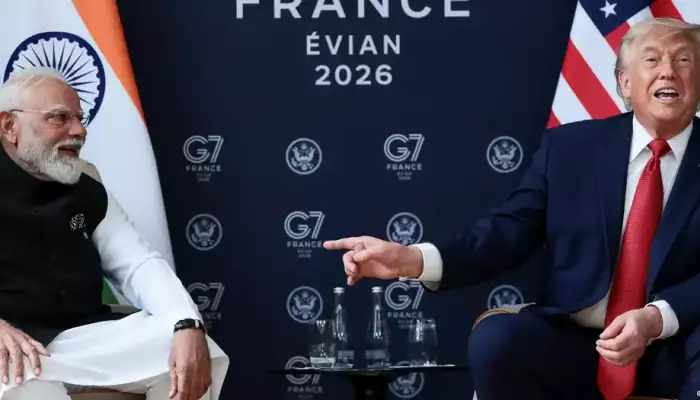
New York: The US Senate has passed a bill that would allow the Trump administration to impose tariffs of up to 100% on goods from countries that purchase Russian oil and gas, including India and China.
The bill, according to US lawmakers, is aimed at curtailing Russia’s funding for its war in Ukraine.
The Lindsey O Graham Sanctioning Russia and Iran Act of 2026 was passed with an overwhelming vote of 86-11.
Why is the bill troublesome for India?
India is among the world’s top importers of Russian oil and gas, and its purchase of discounted Russian crudes has gone up since the Russia-Ukraine war began in 2022. With the conflict in the Middle East disrupting energy markets, Russian crude has become an important alternative source for Indian refiners.
If 100% tariffs are imposed on Indian goods exported to the US, it will make them significantly more expensive, which could force US importers to look for alternative suppliers.
The bill does not automatically impose tariffs, but rather allows US President Donald Trump the discretion to impose them, with the implementation depending on the final law and subsequent executive decisions.
India needs to start de-risking from US: Foreign affairs experts
Foreign Affairs experts have suggested that India begin strategic de-risking from the United States, asserting that mounting economic tensions in the wake of the US Senate passing the Russia sanctions bill could signal a permanent shift in bilateral relations rather than a temporary hurdle. Experts also criticised the legislation as a stark example of the extraterritorial application of US laws.
Foreign affairs expert Sushant Sareen noted that while Donald Trump previously imposed a 25% tariff on India for buying Russian oil, upcoming measures could escalate further.
“The US has been taking these kinds of actions,” Sareen stated, highlighting the legislative momentum fueled by figures like the late Senator Lindsey Graham.
Sareen pointed out a historical precedent, stating, “Generally, what we have seen is that these kinds of bills have opt-out clauses, where the president can certify that it is not going to implement this particular law simply because it’s not in the American national interest. Now, they would certainly have that opt-out clause.”
However, Sareen questioned whether Washington would apply such severe punitive measures universally, specifically asking, “Will the Americans impose the same law on China of a 100% tariff?” He added, “And chances are that they will not because the Chinese will retaliate...”
Emphasising the long-term implications for New Delhi, Sareen urged policymakers to abandon the mindset that current friction is fleeting.
“I think India needs to get over that sense that this is a temporary phenomenon, it’s a temporary kind of a problem which has come between India and the United States,” he said. “I think this is signalling a much more permanent kind of a breach.”
While clarifying that economic ties would not vanish entirely, Sareen warned that implementing aggressive measures like a 100% tariff would effectively mean “the economic relationship does not exist anymore.”
Consequently, he concluded that India must adapt its foreign policy framework: “The question is, what does India do about it? I think just as India has thought about de-risking itself from China, I think India now needs to start moving towards de-risking from the United States as well. Because very clearly, the US under Trump, and maybe even after Trump, will remain a hostile power...”
Former diplomat Mahesh Sachdev criticised the legislation as a stark example of the extraterritorial application of US laws, arguing that Washington is exceeding its authority by attempting to penalise third-party nations.
“This bill is a clear example of extraterritoriality of US laws, which has been lately evident in multiple ways,” Sachdev said. “It is clearly beyond the United States’ remit to impose such duties on a second country and a third country. It is a clear violation of rule-based international trade order and could even vitiate the energy markets worldwide.”
Sachdev highlighted the potential shockwaves for major energy consumers, particularly China and India. He warned that forcing these nations off Russian and Iranian energy would distort global supply chains.
“If these countries are forced to stop buying oil from Russia and resort to open market purchases, it will cause a great disruption in the market,” Sachdev explained. “While crude from Iran and Russia would be cheaper because there are no buyers, the rest of the world’s crude would rise in prices because there are too many buyers.”