Tuesday 08 / September / 2026
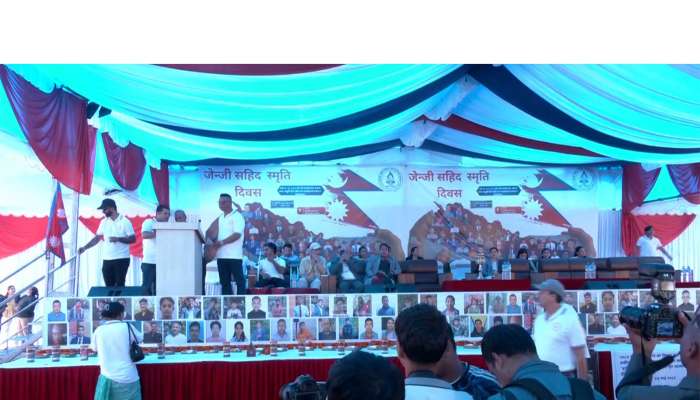
Kathmandu: Nepal on Tuesday observed the first ‘Gen Z Martyrs’ Day’ in memory of the Gen Z movement of September 8 and 9, 2025.
Recognising the sacrifices of those killed during the protest, a commemoration event was held in Baneshwor in Kathmandu in the presence of the injured, families and next of kin of those killed on the first day of the “Gen-Z uprising”.
The ceremony started with the chanting of hymns by the priests calling for the emancipation of the departed souls on the first anniversary of the protest.
They lit the lamps in front of the photos of those who died during the protest that brought the wave of political change in the Himalayan Nation.
They say the day should not be viewed merely as a public holiday, but as a reminder of the sacrifices made by young people and a renewed commitment to good governance, accountability and a better future.
“This government is not fully adopting the spirit of Gen Z nor going the way it should have gone. The government is not very capable of adopting the spirit of Gen Z because of the lack of time, and sometimes it seems that the government officials and the ministers- the stakeholders of Gen Z who are in parliament do not seem to be capable of doing the jobs,” Kiran BK, who took part in last year's protest and came to the old parliament building to attend the one-year commemoration ceremony, told ANI.
Young people, including Gen Z leaders and families of martyrs, have mixed expressions about the present government led by Prime Minister Balendra Shah, saying it has partially raised hopes that the spirit of the movement can be translated into meaningful reforms.
The interim government led by Sushila Karki, on November 3, 2025, declared 45 people martyrs, out of which 42 were declared as “Gen Z Governance Warriors” and three police personnel as immortalised police personnel and decided to observe Bhadra 23 of the Nepali calendar (September 8) as Gen Z Martyrs’ Day every year.
However, a total of 77 people died during the protests on September 8 and 9, 2025. For many members of Generation Z, the day signifies both pride and pain.
“When I think of that day, the only word that comes to my mind is terror. It was very, very difficult for us to go through that day, and after that, now, when we remember the day, it’s only bad memories nothing more than that, nothing less than that, only bad memories. It was blood everywhere; people were crying and terrified,” Astha Shrestha, one of the attendees of the commemoration event who has her office near the former federal parliament, told ANI as she recalled her day a year before.
“Obviously there ought to be political changes after all that happened in the last year, though if I think of it as of now, I would say I am not completely satisfied with how the government is going, but also I am not disappointed, so I think that’s a win for us because whatever changes they brought in and sacrifice they made they could do from their side to make Nepal a better place,” Shrestha added.
The Gen-Z uprising of September 8 and 9 brought a wave of change in the Himalayan Nation buffered between India and China.
The two-day protest, which resulted in the deaths of at least 77 people forcing then communist leader KP Sharma Oli to resign from the post; an interim government was formed after the dissolution of the parliament.
The post-mortem report of those killed in police firing in Kathmandu Valley states death due to bullet injuries to the head and chest. During the protest, police were only allowed to fire on the protestors below the knee to control the situation.
The Police also used some lethal weapons to crack down on the protestors, following which the former Home Minister Ramesh Lekhak stepped down from the post. But Oli remained adamant about resigning despite rising pressure.
The Himalayan nation, after five days of deliberation and debate, appointed Former Chief Justice Sushila Karki as the interim Prime Minister, who recommended dissolving the parliament and held the election on March 5.