Saturday 03 / October / 2026
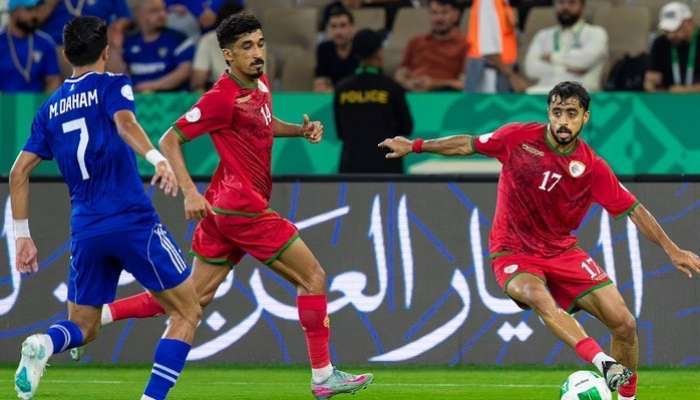
Muscat: Oman’s national football team will face the United Arab Emirates tomorrow at 10:30 pm Oman time in the semi-final of the 27th Arabian Gulf Cup.
Speaking at a press conference held at the tournament’s media centre, Oman’s national team coach said preparations for the match had focused on the desire to secure victory, alongside ensuring the players’ physical and mental readiness.
Meanwhile, attention turns tomorrow to the two semi-final matches of the 27th Arabian Gulf Cup, with the four teams reaching the last four — Oman, Saudi Arabia, the UAE and Qatar — showing closely matched levels as they seek places in the final.
A number of analysts believe the four teams have comparable chances of reaching the final.
Sports commentator Ahmed Al Kaabi said knockout semi-finals have their own considerations, regardless of the technical factors or preparations preceding the match, stressing that small details would be crucial in determining the outcome.
He told the Oman News Agency (ONA) that Oman must maintain full concentration from the opening minute until the final whistle and draw on its experience from the group stage, particularly as its starts in the three matches against Iraq, Saudi Arabia and Kuwait were not at the desired level.
He stressed the importance of making a stronger start against the UAE and maintaining concentration throughout the match.
Al Kaabi noted that Oman enters the match with a strong record in Gulf Cup competitions, having reached seven finals since the 17th edition in 2004, winning three and losing four. The team is also among the Gulf sides with the most semi-final appearances.
He explained that Oman is competing in the current tournament during a new phase of renewal and change under the leadership of Moroccan coach Tarik Sektioui, stressing that the transitional phase does not mean abandoning ambitions to compete for the title.
He added that Sektioui has stated on several occasions that the initial objective was to progress from the group stage, which has been achieved, meaning the team must now prepare in the best possible manner for the semi-final.
Regarding the equal chances of the four teams, Al Kaabi said knockout matches can take different turns that alter the course of a game, even when one side appears to have an advantage beforehand. An individual mistake, a tactical change, a poor start or an injury could all affect the match.
He said such encounters represent a test of coaches’ abilities and their technical reading of the game, noting Sektioui’s experience in knockout matches and his achievements with Moroccan national teams and clubs.
He pointed out that knockout matches leave no room for compensation, requiring all four teams to approach the semi-finals with the highest levels of concentration.
He also noted that previous editions of the Gulf Cup had witnessed teams that were not initially considered among the leading contenders, or had not produced convincing performances in the group stage, subsequently improving step by step to reach the final and win the title.
Al Kaabi said Oman’s experience in the previous edition is another positive factor that can be utilised, alongside its familiarity with the nature of decisive matches in the tournament.
On the physical aspect, he explained that playing only three group-stage matches may not be sufficient to fully prepare players for a tournament of this importance, making the management of the physical challenge one of the key tasks facing the coaching staff.
Faisal Al Saeedi, a journalist with Oman newspaper, said the four teams that reached the semi-finals deserved to do so based on their technical performances and positive results in the group stage. He said this points to fierce competition in the semi-finals, which represent a decisive crossroads, with small details likely to play a pivotal role in determining the two finalists on Tuesday.
He told ONA that the four teams have relatively balanced chances given their similar technical levels, while noting a slight psychological advantage for Saudi Arabia due to the home crowd and home conditions in its match against Qatar.
He described Oman’s meeting with the UAE as a different kind of encounter, given its nature as a decisive derby in which technical differences tend to narrow and pre-match predictions become less significant.
Al Saeedi said the four teams’ experience in handling decisive knockout matches, together with their well-rounded squads, are among their key strengths in a tournament that remains open to different possibilities.
He added that group-stage results do not necessarily reflect the expected performance in the semi-finals, which are often characterised by caution, tactical discipline and attempts to exploit defensive positioning and marking errors.
He expects both semi-finals to be tactically cautious, with defensive organisation and quick attacking transitions playing important roles. Each team is likely to look for an opportunity to score and then protect its lead, making open attacking football less likely.
Waleed Al Abri, a journalist with Al Roya newspaper, said there is a consistent principle in the Gulf Cup: no team is unbeatable and no pre-match calculations can guarantee an outcome, particularly at the semi-final stage, which represents a critical turning point in the tournament.
He told ONA that the four teams have equal chances based on lessons from previous Gulf Cup editions, stressing that success in knockout matches depends on how carefully teams deal with each stage.
He cited the final of the 22nd Gulf Cup in Riyadh, when Saudi Arabia lost the title on home soil to Qatar despite being considered the stronger and more prepared side at the time, while Qatar was undergoing a rebuilding phase under coach Djamel Belmadi.
Al Abri said technical differences do not necessarily have a direct impact on results, noting that Oman qualified despite producing unconvincing performances in three halves of its group-stage campaign. He said the team nevertheless reached the semi-finals by believing in its chances, while its optimistic coach remains open to success.
He expects the semi-finals to produce few goals, with all four teams retaining chances of progressing.
National coach Ahmed Al Alawi said: “I believe the semi-finals will be strong and open. The four teams reached this stage because they deserve to be here. For Oman, qualification was not easy, particularly after the draw with Iraq and the need to resort to a draw to determine qualification. The situation is different now because it is a single match, and a mistake could cost the team its place in the tournament.”
On the teams’ chances of reaching the final, Al Alawi said they are closely matched and that no team can be guaranteed a place in the final before the match.
He noted that each team has strengths as well as areas requiring improvement, adding that the side that remains more focused and makes better use of its opportunities will reach the final.
He said the semi-finals are open to all possibilities because they are knockout matches, with psychological factors, concentration and avoiding mistakes playing important roles.
“A full match can be evenly balanced, but one mistake, a set piece or a single opportunity can change the result. That is why the small details will be very important,” he said.
Regarding whether group-stage performances can indicate a team’s ability to compete in the semi-finals, Al Alawi said the group stage provides an indication but does not necessarily determine what will happen in the knockout stage. The group stage allows teams an opportunity to recover from setbacks, whereas there is no second chance in knockout matches.
He added that Oman produced varying performances during the group stage and that the priority now is to start the match against the UAE with confidence and concentration and deliver its best performance.
Al Alawi stressed that small details could play a decisive role in determining the finalists, saying: “In matches like these, details can make the difference. Calmness and concentration throughout the match are therefore very important, and the team that handles these details better will be closer to achieving its objective.”