Thursday 05 / November / 2026
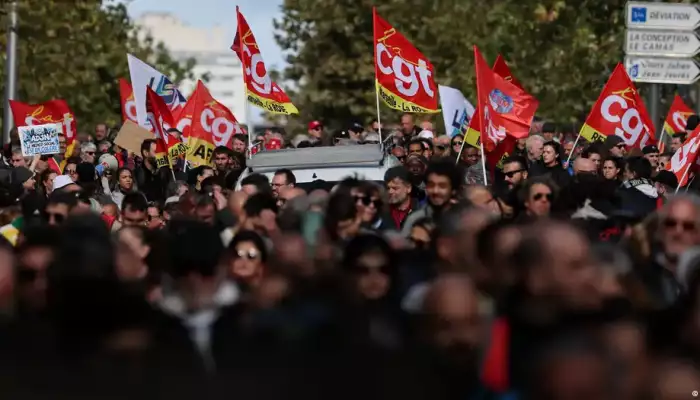
Hundreds of thousands of people marched in French cities on Thursday, as public workers staged a strike alongside protesting students.
The mobilization, called by trade unions seeking higher wages, came after demonstrations over education and the rising cost of living on October 17 triggered some of the worst rioting France has seen in years.
Police were out in force for Thursday's protests, with Interior Minister Laurent Nunez announcing around 70,000 police officers and security forces would be deployed across the country.
Unions said that around 260 rallies were planned nationwide. Authorities estimated some 500,000 to 700,000 people would take part in the demonstrations, including about 80,000 in the capital, Paris.
Demonstrations kicked off in the southern cities of Marseille and Lyon, and Nantes in the west, on Thursday morning.
An official close to Interior Minister Nunuz was cited by the Associated Press as saying that most of the rallies were peaceful, but that there was some violence in Lyon, Nantes, Pau, Orleans, Rennes and Toulouse.
Authorities in the western region of Brittany said "masked individuals" had tried to block roads in the city of Rennes.
BFM TV reported that a high school near the southwestern city of Toulouse was set on fire.
The main protest in Paris began at 2 p.m. local time (1300 GMT).
Reuters reported that high school students and other protesters had already faced off against riot police in the French capital on Thursday morning after they blocked a street with rubbish bins.
Who is striking on Thursday?
Public and private education unions called for staff to walk off the job, as well as unions representing rail workers, public hospitals and postal services.
They are demanding an increase in the minimum wage, across-the-board wage raises, tax reforms and better learning conditions for young people.
The Education Ministry said just over 15% of French teaching staff went on strike. French power unions also joined the action, state-owned utility EDF said.
The Eiffel Tower was shut on Thursday because of the strike.
Media reports said state railway operator SNCF expected only minor disruptions to long-distance services. It was not immediately clear to what extent a strike called by air traffic controllers would disrupt air traffic.
Among those joining Thursday's marches were students who have been protesting for weeks over deteriorating learning conditions. Those demonstrations have grown to include widespread anger over high living costs and inequality.
Although the recent student-led protests have largely been peaceful, some saw clashes with police, with officers using tear gas and water cannons to disperse crowds, as well as rioting and looting.